8 Cyber Resilience Best Practices

by | Aug 31, 2026

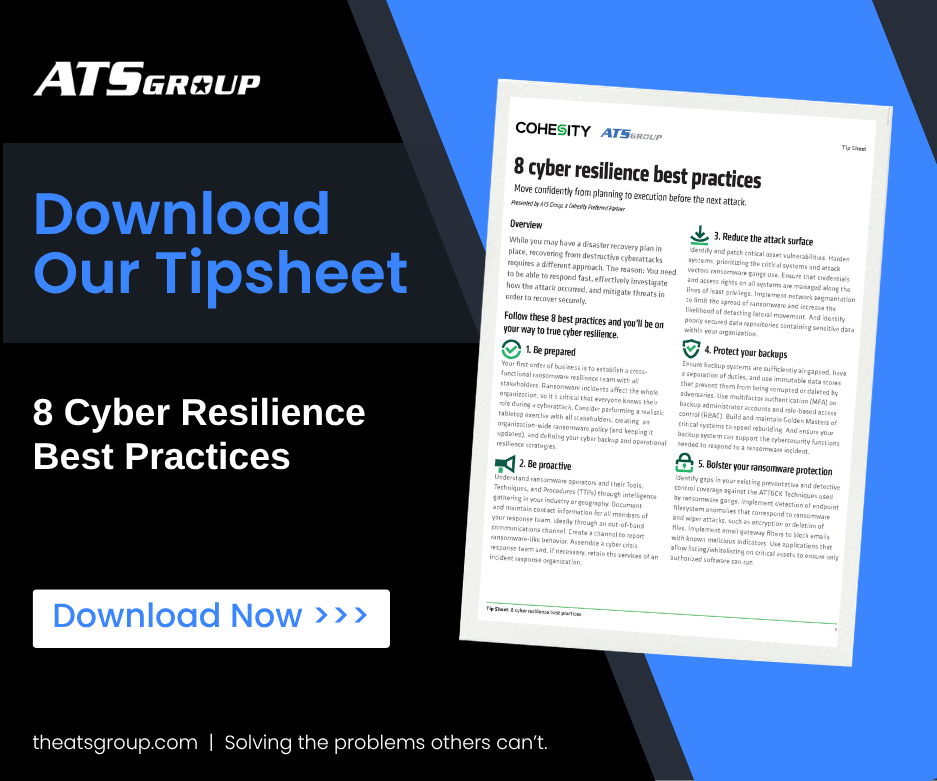
While you may have a disaster recovery plan in place, recovering from destructive cyberattacks requires a different approach. The reason: You need to be able to respond fast, effectively investigate how the attack occurred, and mitigate threats in order to recover securely. Follow these 8 best practices and you’ll be on your way to true cyber resilience.

Move confidently from planning to execution before the next attack.

Ransomware and other cyberattacks can change the requirements for recovery. Organizations need to protect backup data from attack, identify clean recovery points, coordinate response efforts, and restore critical systems with confidence.

This tip sheet from Cohesity outlines eight practical ways to strengthen cyber resilience, including:

  • Protecting backups with immutability and stronger access controls
  • Maintaining isolated copies of critical data
  • Preparing teams and defining response responsibilities
  • Testing recovery processes before an incident
  • Supporting faster, more reliable recovery when an attack occurs
Whether you’re reviewing an established recovery strategy or identifying areas for improvement, these best practices provide a useful framework for evaluating your current approach.


Strengthen Your Cyber Recovery Strategy

ATS Group helps organizations design and implement data protection and recovery strategies built around their infrastructure, business requirements, and recovery objectives.

As a Cohesity Preferred Partner, ATS combines Cohesity’s data security and management technology with the technical expertise needed to put it to work across complex IT environments.
Talk with ATS about cyber resilience

Related Articles

Storage Security Risks in Modern Enterprise Storage

Storage Security Risks in Modern Enterprise Storage

Storage environments are growing more complex, and that complexity is creating real security risk. This article explores how performance instability, misconfigurations, and encryption workflows contribute to storage security risks, and why the industry is shifting critical capabilities closer to the hardware layer.

read more
AIX Adapter Automation: Safer, Smarter Fibre Channel Tuning

AIX Adapter Automation: Safer, Smarter Fibre Channel Tuning

Manually tuning Fiber Channel adapters on AIX systems is risky, time-consuming, and often delayed—putting performance and stability at risk. In this post, we show how Zabbix, Event-Driven Ansible, and Red Hat AAP can be combined to automate AIX fiber adapter configuration safely and intelligently. Learn how to monitor key tunables, detect drift, enforce standards, and minimize disruption with a repeatable, hands-off approach.

read more